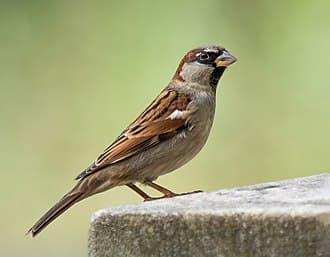
House Sparrow
Passer domesticus
Physical Characteristics
Size
5.5-7 inches (14-18 cm)
Wingspan
7.5-10 inches (19-25 cm)
Weight
0.9-1.1 oz (24-32 g)
Plumage
Males: gray crown, black bib, white cheeks, chestnut nape and back streaks. Females: plain brown with buffy eyebrow stripe
Distinctive Features
Chunky build, thick conical bill, male's black bib and gray crown
Natural History & Behavior
🌳 Habitat
Almost exclusively associated with human habitation - cities, towns, farmyards, parks. Rarely found in undisturbed natural areas.
🍽️ Diet
Primarily seeds and grains, but also insects, scraps, and human food waste. Feeds nestlings insects for protein.
🦅 Behavior
Social and gregarious, often in flocks. Aggressive toward other cavity-nesting birds. Dust-bathing behavior common. Noisy and chattering.
🗺️ Migration Pattern
Non-migratory, sedentary. Extremely site-faithful, often living entire lives within a few blocks.
🎵 Sounds
Simple chirps and cheeps: "chirrup chirrup" and chattering calls. Not musical. Males sing monotonous "cheep-cheep-cheep" to attract mates.
🛡️ Conservation Status
Least Concern globally, though declining in some urban areas in Europe
Fun Facts
Introduced to North America in 1851 in Brooklyn, New York
One of only three bird species mentioned in the Bible (along with turtledoves and pigeons)
Can live in locations from Death Valley to northern Alaska
Population in Britain declined by 71% between 1977 and 2008
They don't walk - they hop!
House Sparrows can swim to escape predators
Frequently Asked Questions
What does a House Sparrow sound like?
House Sparrows make simple, monotonous "chirrup" and "cheep" sounds. Their song is a repetitive series of chirps rather than a musical melody. They also make chattering and scolding calls, especially when in flocks.
Where do House Sparrows live?
House Sparrows live almost exclusively near human habitation - in cities, towns, suburbs, and farmyards worldwide. They're native to Europe and Asia but have been introduced to North and South America, Africa, and Australia. They're rarely found far from buildings.
Are House Sparrows invasive?
Yes, in North America, House Sparrows are considered invasive. They were introduced from Europe in the 1850s and compete aggressively with native cavity-nesting birds like bluebirds and tree swallows for nest sites.
What's the difference between male and female House Sparrows?
Male House Sparrows have distinctive gray crowns, black bibs, white cheeks, and chestnut coloring on the nape and back. Females are plain buffy-brown overall with a lighter eyebrow stripe and lack the bold markings of males.
Are House Sparrows protected?
In the United States, House Sparrows are not protected by the Migratory Bird Treaty Act because they're non-native. However, in their native Europe, they are protected and experiencing population declines in many areas.
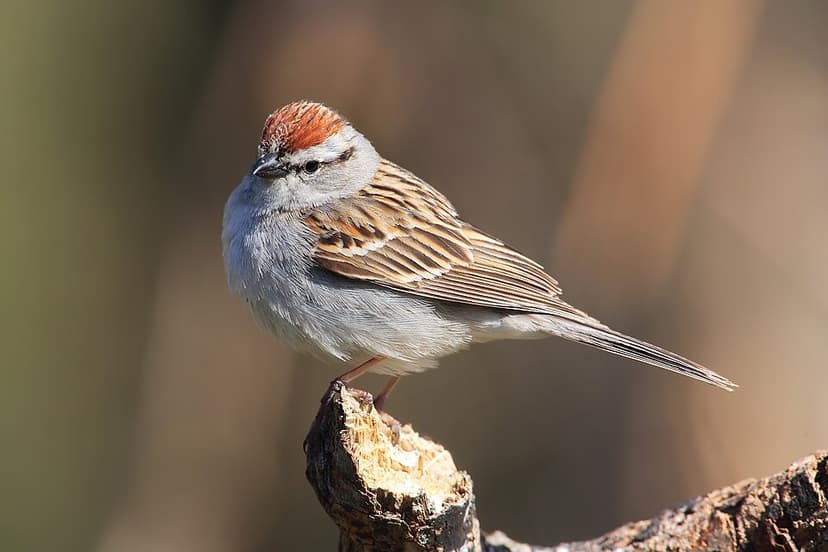
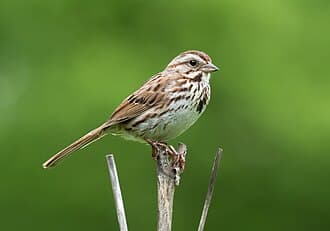
Identify House Sparrow Instantly
Download Bird Identifier to recognize House Sparrow and thousands of other bird species with just a photo